


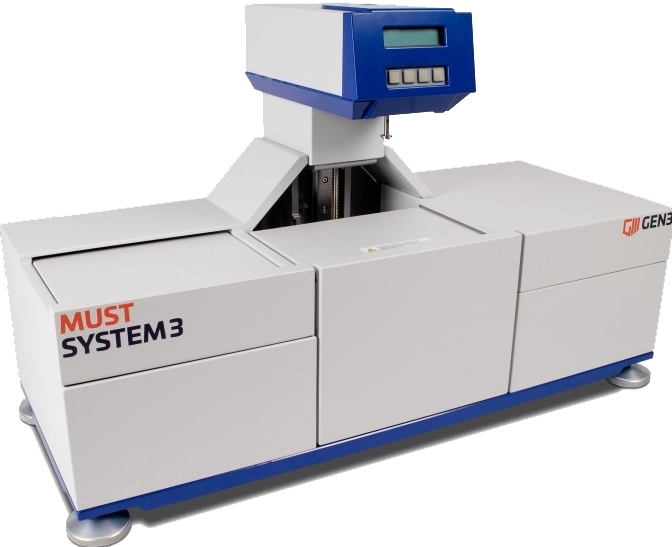
Solderability Tester (Dip Solder Balance) MUST SYSTEM3
1. Heating temperature setting range: Room temperature ~ 350°C;
2. Dip‑solder speed and depth: 0~30 mm/Sec; 0~4 mm;
3. Test time: 0~30 seconds;
4. Max. weight of large component: 40 g (including fixture weight);
5. Solder ball test stand diameter: 1 mm, 2 mm, 4 mm;
6. Solder bath diameter and capacity: 60 mm (750 g);
7. Power supply specification: AC220V±10V, 50/60Hz, 750W.
MUST System3 (also known as MUST3) is a test system specially designed for solderability testing.
MUST stands for Multicore Universal Solderability Tester. The system was originally designed as part of the “Brite” research grant project, partially funded by the former European Economic Community (EEC, now the European Union). This early R&D work was jointly undertaken by Multicore Solders, National Physical Laboratory (UK), Siemens and Philips.
MUST was acquired from Henkel (Multicore Solders) by Gen3 Systems Limited in 2002.
The MUST System has more than 30 years of experience in the field of solderability testing (since 1975) and has served more than 2,500 users worldwide.
The system is based on the wetting balance principle, yet it is designed to adopt the micro‑wetting balance method for testing surface‑mount components. This method also achieves more accurate testing for circuit‑board samples by eliminating the “floating” issue commonly seen in immersion testing. Higher resolution can be obtained by using solder balls instead of the traditional solder immersion bath when applying this method.
The measuring head uses a standard LVDT (Linear Variable Differential Transformer) to measure surface tension and buoyancy acting on component leads. At low immersion speed, high‑frequency force‑signal monitoring detects contact between solder and leads; this allows insulated leads to dip into solder balls or solder baths. At high immersion speed with solder bath, contact with solder is detected via electrical contact between leads and sample holder.
Wetting force is sampled at 1 kHz during test duration of 0‑5 seconds; for test duration exceeding 5 seconds, sampling frequency is reduced to 0.4 kHz after 5 seconds.
The spherical blocker is mounted on an electrically‑driven, computer‑controlled X‑Y worktable. The system can set the starting position for tests; test data and parameters are saved to disk files. These files can be recalled and loaded into software before testing a batch of components.
The motor‑driven table can also automatically move along the side of multi‑pin components, enabling easy testing of each pin on multi‑pin devices.
The bundled software guides operators through test procedures, and pass/fail results can be easily retrieved upon completion of a single test or a sequence of tests.